Rich Dixon is inviting us to think.
+++
Two days after completing the ride, we met in New Orleans with a group called Handicapped Encounter Christ (HEC) including people with a variety of disabilities and the “able-bodied” folks who supported their ministry.
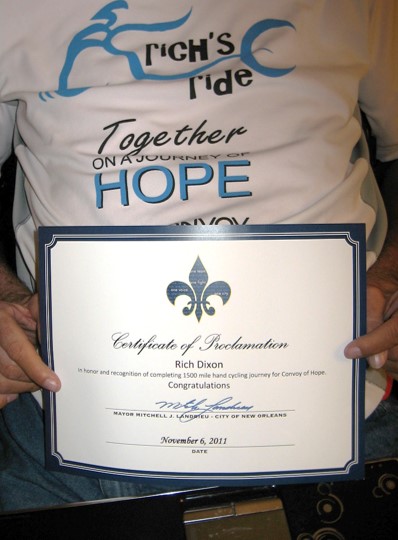
A small group, perhaps twenty-five people, sat on an outdoor patio. They handed me this cool certificate, which proves how easy it is to get a proclamation from a big-city mayor.
I began as I often do with a small audience, asking what they wanted to talk about. After a short pause, Kristin opened with a startling statement posed as a question. I’m frankly still a bit flummoxed by her words.
“You’re doing this amazing project that inspires everyone, especially people like us. Can you tell us how you’re able to function so well in an able-bodied world?”
Before reading further I invite you to ponder those words for a moment. What stands out for you?
I stalled for time, suggesting my friends might offer a different view of her assumption that I “function well.” Everyone chuckled while I searched for a response. I think I understood her intent, but the words revealed something deeper and more significant.
“People like us.”
“An able-bodied world.”
Am I part of “us”? If so, who’s “them”? Do I truly live in “an able-bodied world”? An able-bodied world might tolerate me, even make allowances for me, but I’m at best a resident alien. A guy who’s paralyzed below his chest cannot claim full citizenship in an “able-bodied world.”
Kristin’s question assumed God created an “able-bodied world” for people who meet some arbitrary physical/mental/psychological standards. I guess those of us who fall short ought to stay out of the way and feel grateful we’re allowed to hang out on the edges.
Questions for next time:
Who’s them…and us? Who’s handicapped…and able-bodied?
To be continued…
 300 words a day
Pingback: Design specifications – 300 words a day
Pingback: The Last Ride (For Now) – 300 words a day