As a speech major in college, I had to take a theatre course. One of the required texts was Pilgrim at Tinker Creek, by Annie Dillard. The book was published in 1974, about four years before my class. It resonated deeply with the observational, experiential, rooted-in-nature worldview of the professor.
I didn’t read it.
(I didn’t do most of work in that course. I was upfront with the prof about it. We talked from time to time. I did the lighting for a musical during my senior year.)
But there was something about her style of writing that didn’t click for me. It did click for the Pulitzer committee, and many other people.
A couple years ago, I returned to Dillard through The Writing Life.
I resonated a bit more with her writing. Perhaps nearly five decades to reflect on life helped me.
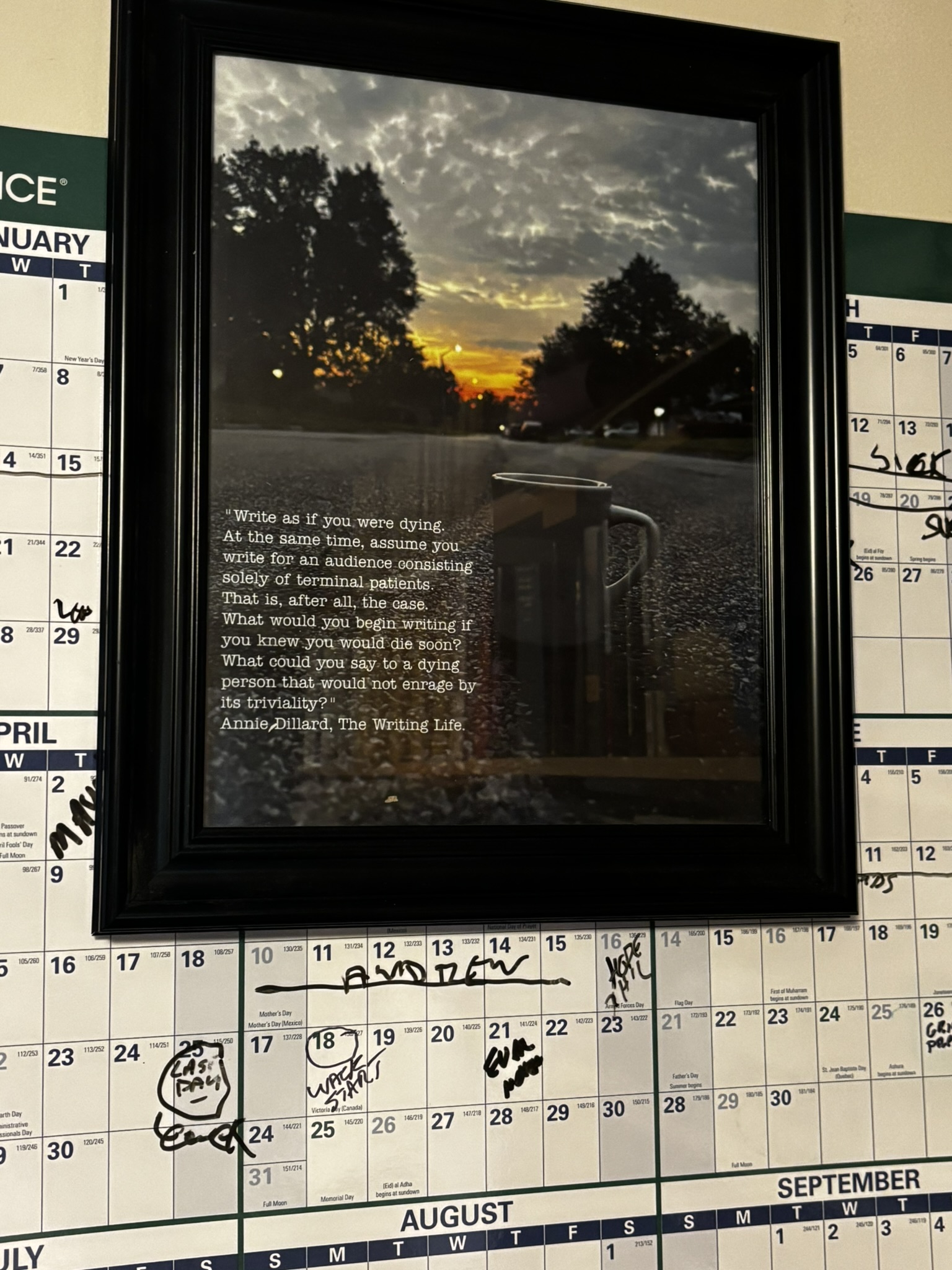
One paragraph in particular in the book grabbed me. I put it on my wall where I could see it as I was working on the grief related writing I’ve been doing the past few years. I’m guessing she was thinking in a broad sense. For me, it was what I was doing every time I went to work.
On Tuesday of this week, I put those words with one of my coffee cup photos. I had a coupon to create an 11×14 poster for $1.99. It’s now above the desk. On Wednesday, her death was announced.
+++
Here’s what helps keep me on track.
“Write as if you were dying. At the same time, assume you write for an audience consisting solely of terminal patients. That is, after all, the case. What would you begin writing if you knew you would die soon? What could you say to a dying person that would not enrage by its triviality?”
I know. It sounds dark. For me, it mostly sounds like life.
+++